Frank
Bird BoxFrank is a former housemate whose notebooks survive him as evidence of a radical, dangerous response to the creatures. In Gary’s account, he rejects Kirk’s quasi-military preparations, yet his own writing insists that the creatures are no threat and casts ordinary survivors as weak-minded obstacles to a world he believes he has already mastered. Malorie’s discovery of one of the notebooks in Gary’s briefcase turns Frank’s private convictions into a crisis for the housemates, while the community’s later history of collective self-blinding frames his ideas against the lethal cost of confronting the creatures directly.
Identity and Background
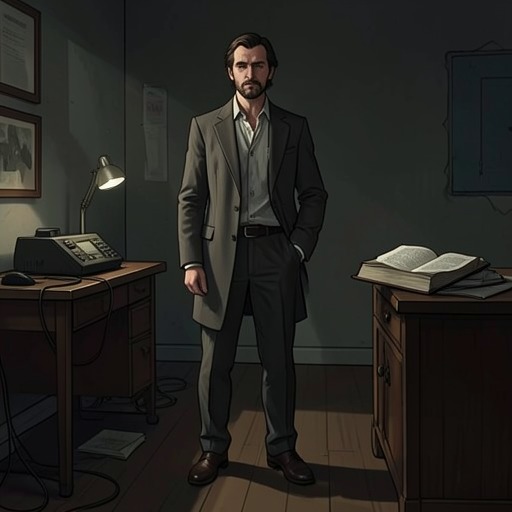
Frank is introduced through Gary’s retrospective account of the house where Kirk had gathered men around plans to fight what he called an invasion. Kirk spoke of weapons, equipment, and guns as though he were a veteran, though Gary says he had never enlisted. The men held drills and made grand claims about protecting the city and ending the global madness, but their preparations produced no results. Frank, by contrast, came to the house because he feared the lawlessness that might spread through the country. He believed the creatures posed no threat, a view that distinguished him from Kirk’s group without making him a reassuring presence.
The contrast between Frank and the others is not simply between passivity and action. While Kirk’s followers performed weaponless target practice in the basement, Frank withdrew to a second-floor bedroom and wrote. Gary describes him as a shut-in who seldom left the room, filling notebooks day and night with pencil, pen, marker, and makeup. The closed door concealed a body of work that Gary could hear before he understood it: furious, laborious writing accompanied by Frank’s whispered denunciations of what he called a cultish, overreactive society. The privacy of the room gives Frank’s dissent an enclosed, obsessive quality; he stands apart from the group, but his isolation does not make his beliefs harmless.
Beliefs and the Notebooks
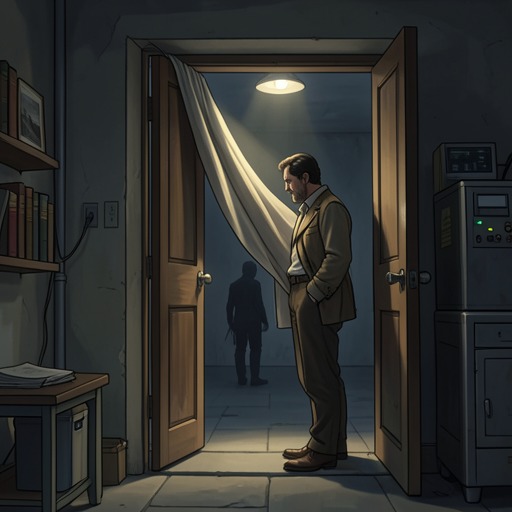
Gary’s first account of Frank’s pages begins with his decision to enter the bedroom while Frank was bathing and the others were occupied downstairs. Although Kirk’s followers dismissed Frank as a useless pacifist, Gary was already frightened of him. In the desk drawer he found dozens of notebooks, their pages crowded with different colors of writing, tiny cursive lines, and large highlighted declarations. Their variation and sheer quantity overwhelmed him. The writing argued that the creatures should not be feared and described people like Gary as small-minded and in need of extermination. Hearing Frank rise from the bath, Gary hurried out; the encounter changed his assessment of the man from a curiosity to a serious threat.
When Malorie later reads the notebook Gary had said Frank took with him, its intricate form makes the doctrine visible as well as legible. Sentences run left to right, right to left, and from the top of the page downward; elsewhere, words spiral into carefully made patterns. The pages are exact and meticulously crafted, but their formal control carries claims of intellectual superiority and contempt. Frank argues that each person has a different mental ceiling and that exposure to the creatures must therefore affect people differently. He presents himself as proof that a mind like his can withstand what overwhelms others, while describing the housemates as hysterical and intellectually inferior.
The notebook also reverses the survivors’ explanation of madness. Frank asks what kind of person hides behind blankets and blindfolds as society collapses, then answers that most people do so because they have been told they will go mad. In his account, fear is not a response to the creatures’ power but a belief that makes people succumb. This interpretation is not an objective account of safety: it is Frank’s own argument, and the earlier writings Gary found include his demand that those he regards as weak-minded be exterminated. His professed confidence therefore cannot be separated from the menace with which he treats everyone who disagrees.
Frank in Gary’s Account
Gary’s narration gives Frank two distinct forms of presence: first as the elusive man behind the closed bedroom door, and later as the author whose pages disclose a coherent, hostile worldview. Gary initially says he had no way of knowing what Frank was writing, though he wanted to find out. After reading the notebooks, he understands why Frank’s distance from Kirk’s group cannot be equated with safety. He even reconsiders Duncan’s alignment with Kirk: beside Frank’s written extremism, the militia-minded men appear to represent a different, not necessarily worse, danger.
The account is nevertheless filtered through Gary, who is explaining events to others while defending the significance of the notebook. His recollections make Frank’s writing consequential but do not establish what ultimately happened to Frank or independently verify every claim in the pages. The distinction matters because the notebook itself is not a neutral record of the creatures: it is an argument by a man who regards his own mind as exceptional and his opponents as expendable. Frank remains absent from the later confrontation, yet his words continue to shape how the housemates interpret Gary and the danger he may pose.
Afterlife of the Notebook and Significance
Frank’s writings re-enter the plot when Malorie interrupts the housemates’ laughter and tells them she has searched Gary’s briefcase. She identifies the notebook as the one about tearing down the blankets, and says it is the notebook Gary had claimed Frank took with him. Her disclosure shifts the object from a private piece of Frank’s history into evidence bearing on Gary’s credibility and conduct. The room falls silent; Tom studies Malorie and turns toward Gary. Frank’s ideas thus become a present-tense conflict among people who must decide how to interpret a document before they can settle what it means for their safety.
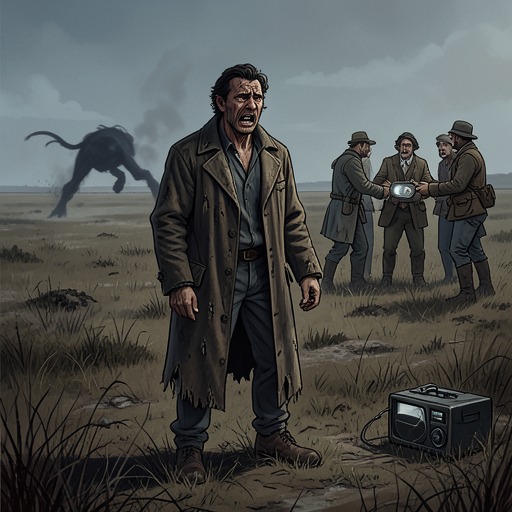
The later explanation of the community’s old practices places Frank’s confidence against a history of catastrophe. Rick tells Malorie that, before the settlement was fortified, a creature entered during a food search and many people died; a mother who had been rational killed four children in a fit of rage. The survivors responded by blinding themselves with whatever they had, including forks, kitchen knives, and their fingers. By the time Malorie hears this, the community has spent a year strengthening its defenses and has had no further security lapse, so Rick says it no longer requires the same burden of self-blinding. Malorie looks to Constance, who bears no scars, and remembers George’s failed video experiments and her own near attempt to blind the children. This history does not prove Frank’s theory; rather, it shows the human cost of the danger his notebook dismisses. Frank’s significance lies in that conflict: he condemns fear as a choice imposed by others, while the survivors’ experience makes blindness a desperate protection, and his language of intellectual superiority turns disbelief into a threat of its own.